Parker’s Audacious Alaskan Beginning
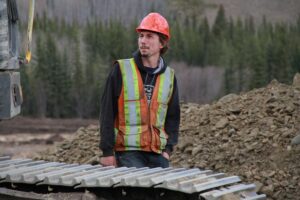
As gold dwindled in the Yukon, a 16-year-old Parker Schnabel made a bold move, investing $100,000 of his own money to acquire a new mining claim in Alaska. This marked a significant shift, as he took over the operation from his grandfather, John Schnabel, in a commitment that defied his age. To achieve his ambitious goal of hitting a massive gold target in the Klondike, Parker implemented a shrewd strategy: he split his crew into two teams. The Wolf Cut Crew was tasked with deep exploration, digging 30 feet to thaw ground for future gold extraction, a costly preparatory phase. Meanwhile, the Drift Cut Crew, led by foremen Mitch and Tyson, focused on immediate gold discovery to keep the operation financially viable. Both teams worked relentlessly, turning Parker’s Alaskan gamble into a high-stakes race against time, with the gold mining world watching closely.

Striking Gold, Overcoming Challenges, and Record Hauls
The two crews faced unique challenges. The Wolf Cut Crew endured slow, monotonous work, moving tons of dirt daily without immediate gold, battling mounting anxiety as operational losses grew. The Drift Cut Crew faced intense pressure to generate immediate income, meticulously panning dirt samples for gold in an unpredictable game of geological hide-and-seek. Parker tirelessly managed both sites, grappling with immense stress and costs.
The long-awaited breakthrough finally came when the Wolf Cut Crew hit incredibly rich “pay dirt,” with the sluice box practically glowing with gold. Almost simultaneously, the Drift Cut Crew also struck a substantial deposit, proving the brilliance of Parker’s two-team strategy. News of his double success spread, establishing Parker as a serious force in gold mining.
With gold pouring in, Parker focused on a massive deposit. However, equipment breakdowns became the new challenge. His aging wash plant, a rented machine, was unreliable. The crew aimed to set up their own “Mighty Big Red” wash plant, a laborious process involving precise assembly of huge components like the tailings conveyor. A pivotal moment came when Parker closed off public access to the gold-rich area, safeguarding his lucrative find. Two years later, his Alaskan site was a massive operation, aiming for an ounce of gold per hour of machine run time. Their first weigh-in yielded over $23,000 in gold in just one hour, a clear sign of immense riches.


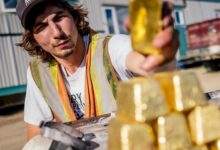

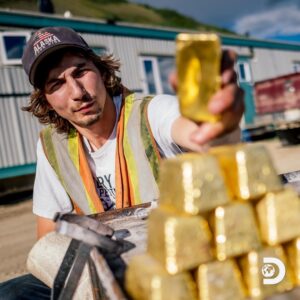
The success continued. During one spectacular cleanup, they had three pans overflowing with gold, and one day they weighed in a stunning 253.8 ounces, valued at over $820,000. By that point in the season, their total stood at an incredible 7,381.1 ounces. Parker generously rewarded his crew with a $122,000 bonus in gold each.
However, new problems arose: rocks clogged Big Red due to a torn internal screen. Mitch had to replace the giant, heavy screen himself. After repairs, Big Red yielded an impressive 51.6 ounces ($90,000) in its first cleanup. Another wash plant, “Sloohifer,” produced an amazing 210 ounces, and then a massive cleanout yielded an astonishing 360.5 ounces (almost $600,000). With such rich ground and massive cleanups, Parker made the executive decision to shut down all public access to his mine, fiercely protecting what he believed was one of the richest pay streaks of his career.
Rumors, Controversies, and the Unseen Side of Gold Rush
While Parker Schnabel’s extraction of over $14 million in gold is a tale of triumph, the hit TV show “Gold Rush” has spawned numerous fan theories about what happens off-camera. One widely debated theory is “producer’s gold,” suggesting that if a crew falls slightly short of a season’s target, producers might discreetly add gold to enhance the dramatic finale, driven by network pressure for a satisfying ending.
Another theory concerns the complex land deals, particularly Parker’s leases from Tony Beets. Fans speculate that the royalty arrangements are more intricate than shown, possibly involving secret bonuses for exceeding targets or penalties for failing to meet them. Some even believe the on-screen rivals, Parker and Tony, might be friendlier behind the scenes, strategically playing up drama for the cameras due to mutually beneficial business deals.
The most intriguing theory involves “lost gold,” suggesting miners conduct unfilmed cleanups and quietly sell “off-camera gold” to private buyers. This would provide steady cash flow for expenses and imply their actual earnings are even higher than the show’s incredible figures. Questions also arise about the crew; a mining operation of Parker’s scale requires more workers than those seen on camera, leading to speculation about their compensation—fixed salaries versus a percentage of gold.
While these theories remain rumors, they add intrigue to gold mining. The show’s history also includes real on-camera meltdowns, notably the Hoffman crew’s disastrous trip to Guyana. Years before Parker’s rise, Todd Hoffman’s crew, once the show’s stars, promised mountains of gold in the jungle but found almost none. Equipment constantly broke down, and the crew was miserable, making it a shocking season and a major scandal within the fan community, highlighting how “gold fever” can lead to expensive failures.
Parker shut the gates on millions in gold. What precisely was he trying to keep out? Was it rival miners, or perhaps, something more profound—secrets?